What Two Years of Yard Testing Looks Like
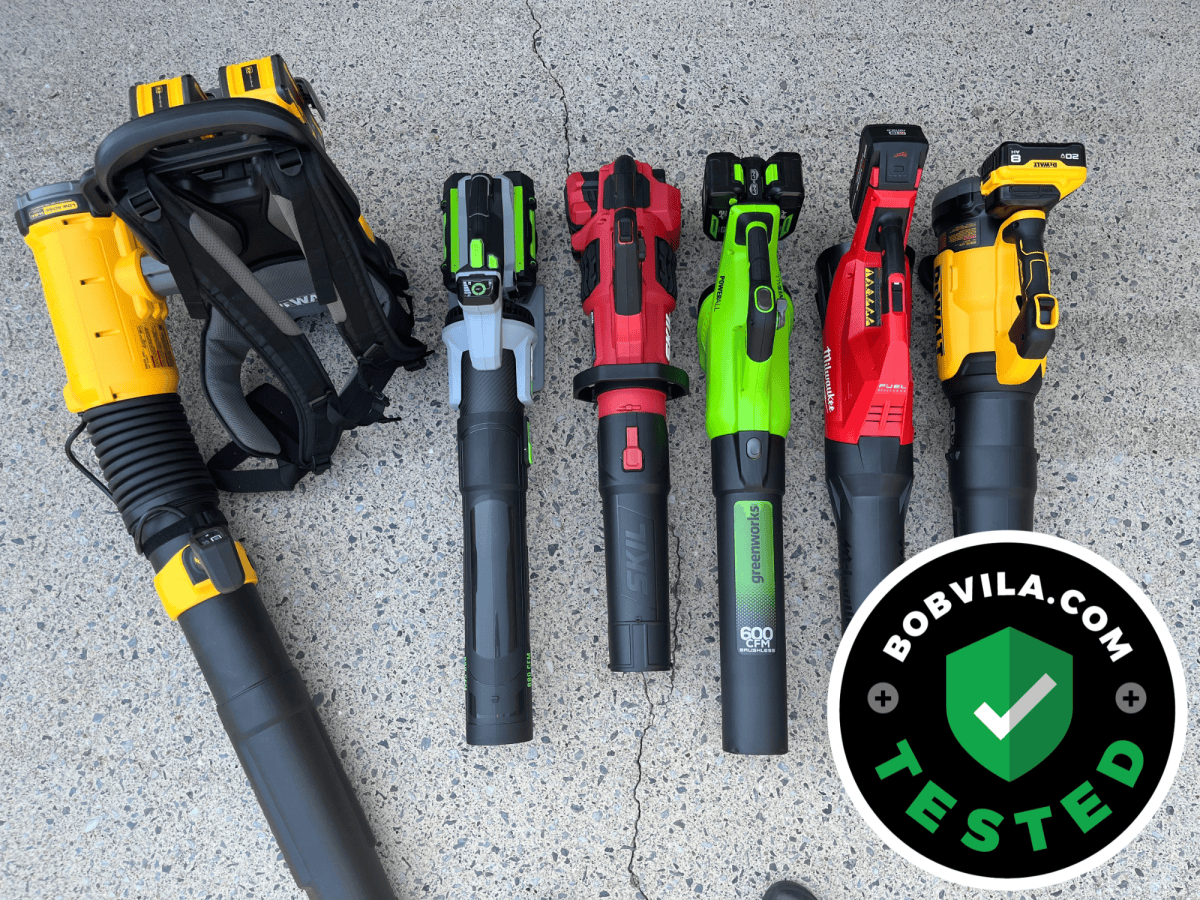
Picking the wrong cordless leaf blower does not just cost money - it costs time. A unit that runs out of charge halfway through clearing a large yard, or one that lacks the airflow to shift wet leaves, turns a 15-minute job into a drawn-out frustration. Over the past two years, the team at Bob Vila tested 26 cordless leaf blower models in real yards, covering everything from compact handheld units to full backpack systems. The nine models below represent the strongest performers across different categories: yard size, budget, weight, and battery life.
Battery-powered blowers have continued to multiply as gas models fall out of favor, which makes the buying decision harder, not easier. The specs that matter most - cubic feet per minute (CFM) for volume, miles per hour (mph) for speed, and amp-hours (Ah) for battery capacity - are not always presented consistently between brands.
Best Overall: Toro 60V MAX 900 CFM Cordless Leaf Blower
Power source: 60V, 4 Ah battery Maximum airflow: 900 CFM / 165 mph Weight: 11.4 pounds
The Toro 60V MAX earned the top overall spot through a combination of blowing force, battery endurance, and usability. At 900 CFM, it moves more air volume than most handheld competitors on this list. The variable-speed trigger gives fine control at lower settings, while a turbo mode and cruise control option handle sustained heavy work without requiring constant grip pressure.
Ergonomics hold up during longer sessions. The handle is well-balanced, and controls are positioned intuitively. That said, at 11.4 pounds it is the heaviest handheld on this list, and there is a slight delay after pulling the trigger before full power kicks in. It is also not the cheapest option. For small yards, the power may be more than necessary. But for medium to large properties where battery life and raw output matter, it is the most well-rounded choice tested.
Best Value: Greenworks PowerAll 48V 600 CFM Cordless Leaf Blower
Power source: Two 24V, 4 Ah batteries Maximum airflow: 600 CFM / 150 mph Weight: 8.5 pounds
The Greenworks PowerAll runs on two 24V batteries working together, totaling 48V. At 600 CFM and 150 mph, the airflow numbers are lower than the Toro, but the weight drops to 8.5 pounds. For routine yard maintenance on smaller or mid-sized properties, that balance of output and lighter handling is practical. The PowerAll designation refers to the battery platform’s compatibility across Greenworks tools, which adds value if you already own equipment in that ecosystem.
Most Powerful: Ego Power+ 880 CFM Cordless Blower
Power source: 56V, 4 Ah battery Maximum airflow: 880 CFM / 200 mph Weight: 9.8 pounds
The Ego Power+ reaches 200 mph, the highest wind speed among the handheld models tested. At 880 CFM combined with that speed, it delivers serious force for moving heavy debris or wet leaves that lower-powered units struggle with. Weighing 9.8 pounds on a 56V, 4 Ah battery, it sits in a reasonable middle ground for weight. The combination of high CFM and high mph makes it the strongest performer in raw output terms among the handheld options reviewed.
Best Battery Life: Husqvarna 350iB Leaf Blaster
Power source: 40V, 7.5 Ah battery Maximum airflow: 800 CFM / 200 mph Weight: 10 pounds
The Husqvarna 350iB stands out for its 7.5 Ah battery - the largest capacity on any handheld model in this group. More amp-hours generally means longer run time per charge, which matters for larger properties or extended cleanup sessions. At 800 CFM and 200 mph, the output is strong enough to compete with the most powerful options. The 10-pound weight is manageable. If running out of battery mid-job has been a recurring problem, this is the model to consider.
Best Lightweight: Milwaukee 3017-21HD M18 Fuel Blower Kit
Power source: 18V, 12 Ah battery Maximum airflow: 500 CFM / 120 mph Weight: 8.5 pounds
At 8.5 pounds, the Milwaukee M18 Fuel ties the Greenworks as the lightest handheld option tested. The 18V system is part of Milwaukee’s broader M18 battery platform, meaning users already in that ecosystem can share batteries across tools. The trade-off is output: at 500 CFM and 120 mph, it produces the least airflow of any handheld in this roundup. For light debris, grass clippings, and small paved areas, that is sufficient. For shifting heavy or wet leaf piles, the lower numbers will show.
Best for Small Yards: Skil 40V 650 CFM Leaf Blower
Power source: 40V, 6 Ah battery Maximum airflow: 650 CFM / 170 mph Weight: 9.7 pounds
The Skil 40V offers 650 CFM and 170 mph on a 6 Ah battery, placing it in a mid-range position for both output and capacity. The 170 mph speed is competitive, even against more expensive models. At 9.7 pounds it is not the lightest, but the overall spec set suits smaller yards well, providing enough power for routine seasonal clearing without the weight and bulk of higher-output machines.
Best for Large Yards: DeWalt 60V MAX High Power Brushless Blower
Power source: 60V, 4 Ah battery Maximum airflow: 760 CFM / 160 mph Weight: 10.5 pounds
DeWalt’s 60V MAX brushless blower targets larger properties through consistent power delivery rather than the single highest peak number. At 760 CFM and 160 mph, the output is strong, and the brushless motor is designed to maintain efficiency over longer use. The 60V, 4 Ah battery is the same voltage platform as the Toro overall pick. At 10.5 pounds it is a mid-weight option. For users already working within DeWalt’s 60V FLEXVOLT battery system, this is a natural fit.
Best Backpack: DeWalt 60V MAX 855 CFM Cordless Backpack Blower
Power source: Two 60V, 5 Ah batteries Maximum airflow: 855 CFM / 160 mph Weight: 35.6 pounds
The backpack configuration shifts weight from arms to shoulders and back, which matters when covering large areas for extended periods. This DeWalt model runs on two 60V, 5 Ah batteries and produces 855 CFM at 160 mph. The total system weight is 35.6 pounds - more than four times the weight of the lightest handheld on this list. That weight is the core trade-off. For a large property where sustained run time and reduced arm fatigue outweigh portability concerns, a backpack unit is the practical choice. For smaller yards or occasional use, it is more machine than the job requires.
Honorable Mention: Greenworks 80V 580 CFM Cordless Leaf Blower
Power source: 80V, 2.5 Ah battery Maximum airflow: 580 CFM / 145 mph Weight: 9 pounds
The Greenworks 80V runs at the highest voltage in this group but pairs that voltage with a smaller 2.5 Ah battery, which limits run time compared to higher-capacity options. At 580 CFM and 145 mph, the output is moderate. The 9-pound weight is comfortable. The combination of a high-voltage platform and a smaller battery makes this a reasonable option for shorter, lighter jobs, but users expecting long run times from the 80V spec should note the battery capacity constraint.
Matching the Blower to the Job
Airflow numbers alone do not tell the whole story. CFM determines how much air volume moves at once - useful for shifting large piles. MPH determines how focused and forceful that air is at the nozzle - useful for dislodging stuck debris. A blower with high CFM but moderate mph moves a lot of air in a broad sweep. High mph with lower CFM pushes harder in a narrower stream.
Battery capacity (Ah) affects run time, not peak power. A 4 Ah battery on a 60V platform does not run as long as a 7.5 Ah battery on a 40V platform, even if the voltage difference implies otherwise.
Weight is the factor that becomes most relevant after about 20 minutes of use. The 11.4-pound Toro is manageable for most users on a large yard, but over an extended session that difference from an 8.5-pound model becomes noticeable in the wrist and forearm.
For small yards with mostly light debris, the Skil 40V or Milwaukee M18 Fuel cover the basics without excess. For large, leaf-heavy properties, the Toro 60V MAX or Husqvarna 350iB offer the output and run time to finish the job on a single charge. The DeWalt backpack is the only model suited to very large areas where handheld fatigue would otherwise become the limiting factor - though at 35.6 pounds, it requires its own adjustment period before comfortable extended use.