A Doorway Solution That Predates Central Heating
Before forced-air systems and insulated walls became standard, homes relied on physical barriers to keep warm air from escaping room to room. One of those barriers was the portiere curtain - a heavy drapery hung across a doorway rather than a window. The name comes from the French word meaning “porter” or “doorkeeper,” and the feature itself dates to the Aesthetic Movement of the late 19th century.
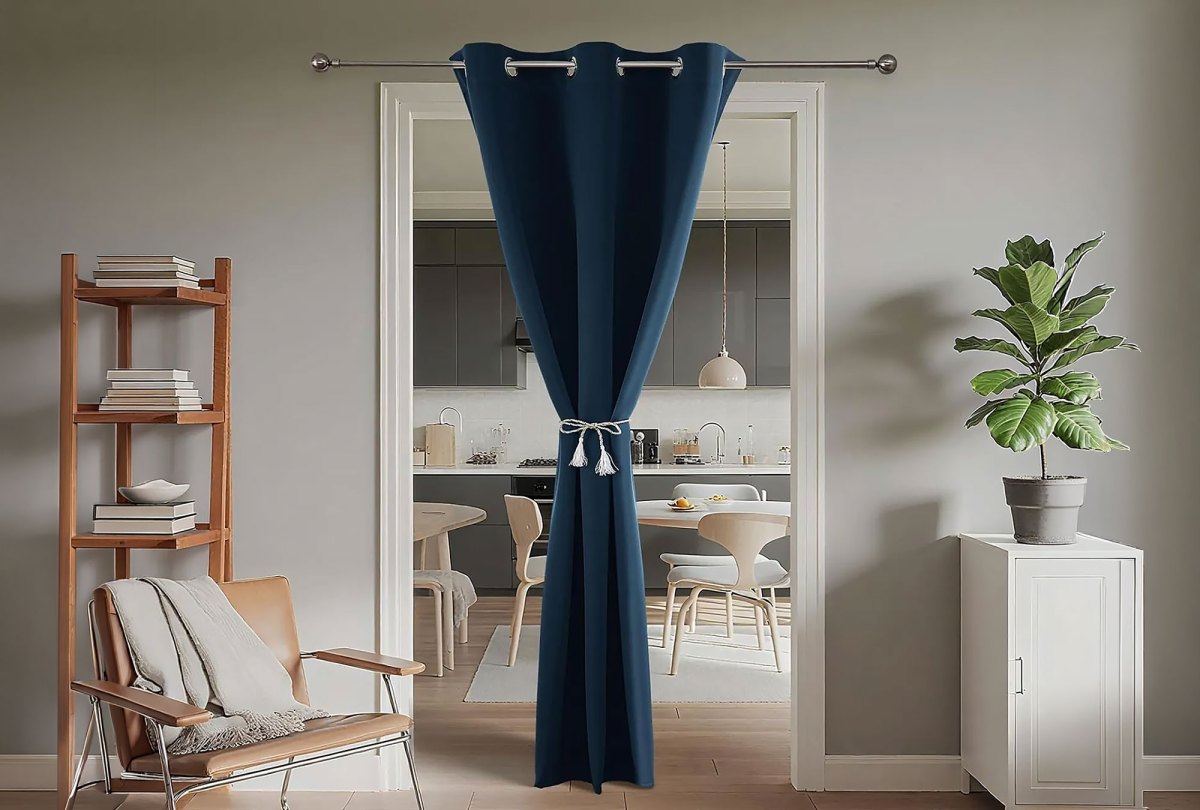
Portieres are not decorative-only pieces. They are functional doorway curtains designed to block drafts, divide spaces, or close off hallways without requiring a permanent structural change. As a category, they are distinct from standard window curtains in both weight and purpose.
What Makes a Portiere Different From a Regular Curtain
The defining feature is fabric weight. Portieres are made from thick, dense materials - velvet, wool, and tapestries have historically been the most common choices - rather than sheer or lightweight textiles. This density is what allows them to do the work assigned to them.
Swati Goorha, founder and principal designer of Swati Goorha Designs in New Providence, New Jersey, describes the traditional construction: “These draperies were normally made from heavier materials like velvet, woolen, tapestries, etc., with design elements being created by folding and hanging them in various ways.”
Because both sides of a portiere remain visible - unlike a window curtain where the back faces a wall - the construction accounts for that visibility. They are typically hung within the doorway frame, and the backing is either made from a decorative fabric or concealed with deep hems so the curtain presents cleanly from either side.
How They Reduce Drafts
The principle is straightforward. A portiere creates a physical fabric barrier across a doorway opening, limiting the movement of air from one room into another. Goorha explains it directly: portieres “can still help reduce drafts by providing a physical barrier of fabric to limit the flow of air from one room into another or from entering a doorway due to its draughty condition.”
The denser the weave and the heavier the fabric, the less opportunity air has to pass through the material. This is why velvet and tightly woven wool outperform lighter fabrics for this application. A sheer or open-weave curtain will not provide the same draft reduction.
Hanging position also affects performance. To get the most out of a portiere, it should be hung above the door opening so enough fabric drops down to cover the entire opening with minimal gaps at the sides. Air moves through gaps, not just through the weave of the fabric itself, so a curtain that leaves significant space at the edges or falls short of the floor will be less effective than one that fits the opening closely.
Back before central heating systems existed, this was one of the primary ways rooms were kept warm. In older homes with larger openings or doorways without doors, the logic still holds.
Privacy Without a Solid Door
A portiere provides a degree of visual privacy - enough to define a space as distinct without fully sealing it off. Sheeja Nair, owner and principal designer at Raashi Design in San Ramon, California, notes that living rooms, bedrooms, dining rooms, and hallways can all benefit from portiere curtains, which “add a sense of privacy while softening the edges between rooms.”
Goorha frames the privacy benefit in practical terms: “The most desirable advantage of using a portiere is that you are able to create private space, such as a home office, a reading nook, or a dining room, but still be able to connect those spaces at any time by simply opening the curtains.”
This distinction matters for how you plan to use one. A portiere creates visual separation and some sense of enclosure. It does not provide the same level of noise reduction or security as a solid door - Goorha is explicit on this point. If the goal is soundproofing or securing a room, a curtain is not a substitute for a door. If the goal is carving out a defined area that can be opened back up easily, it works well for that.
Where Portieres Make Practical Sense
They are particularly useful in older homes, which tend to have larger doorway openings than newer construction. Goorha notes this directly: one reason this type of solution fits older homes is that these homes often have larger openings. In smaller homes, a swinging door can disrupt traffic flow in tight spaces - a curtain that pushes neatly to the side when not in use does not create the same problem.
Specific use cases that come up in practice: closing off a hallway without building a wall, separating a home office from an adjacent room without a door, or dividing a dining space from a living area in an open floor plan. The curtain can stay pushed back most of the time and pulled across when privacy or draft reduction is needed.
Installation Basics
The rod goes directly above the door opening. When the portiere is not in use, it pushes against the wall, keeping the doorway clear. An alternative mounting approach uses rings inside the doorframe, which allows the curtain to open and close smoothly from both sides - relevant if you are pulling the curtain closed regularly rather than leaving it in one position.
Because the curtain needs to cover the full opening without significant gaps, measuring before purchasing fabric or a pre-made portiere matters. The curtain should hang from above the door frame and reach close to the floor, with enough width to cover the doorway and allow for fabric fullness without leaving open edges where air can move through.
Fabric Selection and Maintenance Considerations
Velvet remains a common choice and performs well for both insulation and appearance. Wool and tapestry-style fabrics are also traditional options. All of these require care that differs from standard curtain fabrics.
Velvet is prone to crushing if folded or compressed - when storing or cleaning, keeping it hanging or rolled rather than folded helps preserve the pile. Wool can shrink with heat or agitation, so dry cleaning or cold water hand washing with minimal wringing is typically the appropriate approach for wool portieres. Tapestry-weight fabrics vary by fiber content, so checking the care label before washing is necessary rather than optional.
Regular maintenance for a portiere in an actively used doorway means more frequent dusting or vacuuming than a window curtain would require, since the fabric is handled when the curtain is pushed open and closed. Using the upholstery attachment on a vacuum and working in the direction of the fabric’s nap (for velvet) keeps the surface cleaner without damaging the material.
If the portiere is doing its job as a draft barrier, it will also collect dust along its edges where air movement concentrates. Running the vacuum attachment along the lower hem and the side edges periodically addresses this without requiring a full wash.
What the Fabric Weight Determines
Fabric weight is the variable that controls most of what a portiere can and cannot do. A lighter fabric may hang in a doorway and provide some visual separation, but it will not reduce drafts effectively because air moves through it too easily. A heavy velvet or dense wool limits airflow because there is less space between fibers for air to pass through.
The same logic applies to noise: denser, heavier fabric absorbs more sound than thin material, but even the heaviest portiere does not match a solid door for sound reduction. The relationship between fabric density and performance is a matter of degree, not a binary.
For homes with genuinely drafty doorways - older construction, gaps at door frames, rooms that lose heat quickly - the fabric weight decision is the most important one to get right.