Before You Pick Up a Rake
There is a strong case for not raking at all. David Mizejewski, a naturalist with the National Wildlife Federation, argues that fallen leaves serve a real ecological function. “They are an important habitat for all sorts of wildlife from songbirds to butterflies and moths; even some of our native bees rely on that natural layer of leaves that fall as habitat,” Mizejewski says. He also points out the waste angle: “If you throw them all away in the landfill, not only does that completely eliminate the habitat for these wildlife, it’s also throwing away a valuable resource.”
That said, leaves allowed to accumulate heavily on a lawn can smother grass and impede the growth of cool-season grasses, and dense leaf piles can attract pests. So while leaving some leaves has genuine benefits, a lawn buried under a thick mat of them has its own problems. What follows covers how to rake more efficiently when you do decide the job needs doing.
Wait Until the Trees Are Done
Starting too early is a common source of unnecessary work. If a tree still has most of its leaves, raking beneath it accomplishes little. Within days, the ground will look the same as before you started.
Waiting until trees are nearly bare before starting means you are likely to rake only once. Depending on the trees in the yard and local conditions, full leaf drop can take a few days to a few weeks. Patience here directly reduces the total time spent on the job.
Dress for It
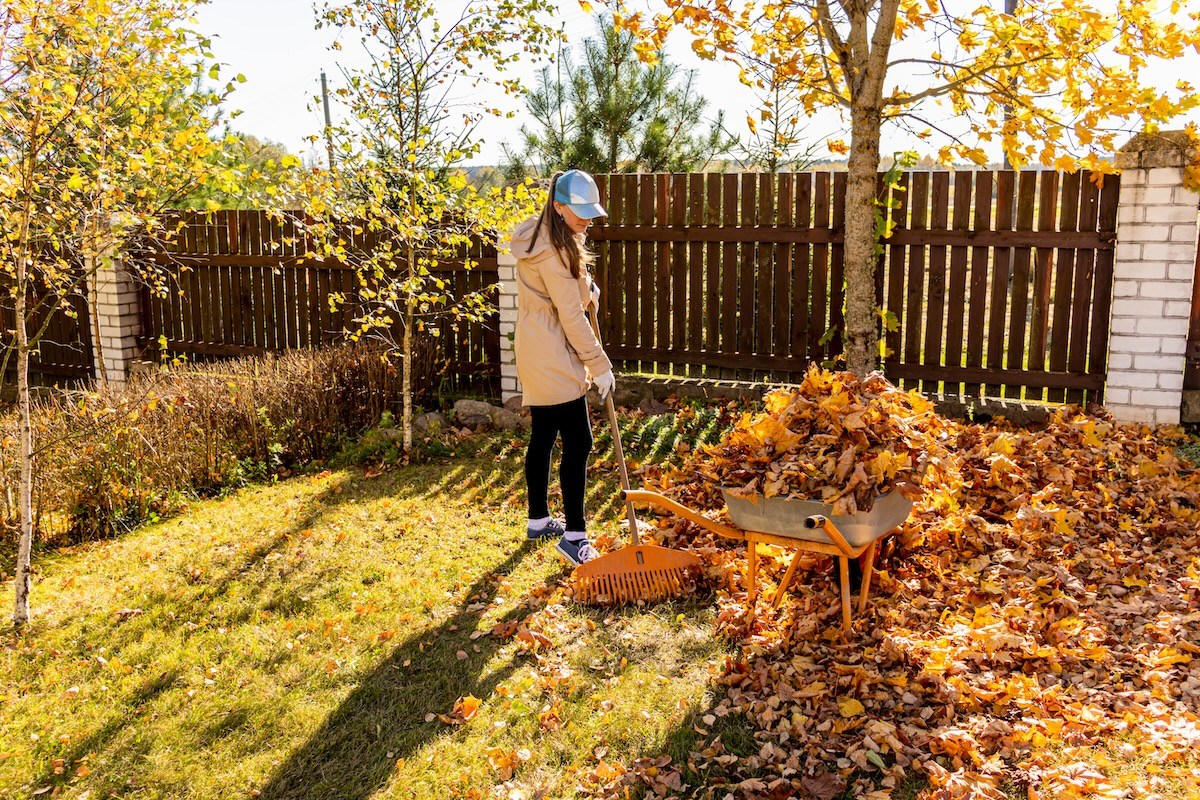
Raking stirs up dust and debris, so clothing choices matter more than they might seem. A hat, long-sleeved shirt, and long pants keep leaf dust and small debris off skin. Work gloves protect against blisters that form when a rake handle rubs against bare hands through repeated strokes, and they provide some warmth on cold autumn days.
Technique also affects how physically demanding the job is. Standing up straight while raking, rather than hunching over the handle, reduces strain on the lower back. Switching the leading hand on the rake frequently distributes the load between both arms and helps prevent shoulder and arm fatigue from building up on one side.
Choosing the Right Rake
Rakes vary considerably in tine width and design, and the difference is not trivial. Rakes with narrow tine spreads collect fewer leaves per stroke, which means more passes to cover the same ground. Wider tine spreads of around 30 inches gather more leaves per stroke and reduce the time needed to clear an area.
Tine design is also worth attention. Rakes labeled “no-clog” typically have angled tines designed to gather leaves without piercing and trapping them, which causes the frustrating clumping that slows progress. The True Temper Clog Free Rake is one example of this design. True Temper also makes a 26-inch dual-tine poly leaf rake with alternating straight and curved tines, which collects leaves and debris without clogging based on its design specifications.
The right rake for one person may not suit another. Handle length, rake width, and weight all factor into comfort during extended use. If you are buying a new rake, handle length in relation to your height is worth checking before purchasing - a handle that is too short forces you to hunch, and one that is too long reduces control.
Work With the Wind, Not Against It
Wind is either a minor advantage or a significant obstacle, depending on which direction you rake. On a day with a gentle breeze, raking in the same direction the wind is blowing means the air movement helps carry dry leaves along, adding to each stroke rather than canceling it out.
Raking against the wind has the opposite effect. Each stroke lifts leaves briefly, and the wind blows some of them back in the direction you just cleared. The work is harder and the results are worse.
On days when the wind is genuinely brisk, the source advice is direct: do not rake at all. By the time a section is cleared, leaves blown in from neighboring properties are likely to have replaced what was raked up. The effort does not produce a lasting result under those conditions.
The Quadrant Method
Raking everything toward the center of a lawn and then managing one large pile seems intuitive, but it involves a lot of unnecessary back-and-forth across ground you have already covered.
A more efficient approach is to divide the lawn into four sections and work through each one separately. Within each section, rake leaves into rows rather than a single heap, working from one end of the section to the other in a grid pattern. This keeps the area being worked manageable, reduces the distance you have to push leaves, and produces a more thorough result because the coverage is systematic rather than reactive.
Each quadrant can be cleared and the leaves moved before moving to the next, rather than accumulating leaves across the whole yard and then dealing with a large, unwieldy mass.
Moving Leaves Without Extra Trips
Once leaves are raked into rows or piles, moving them to a final destination - compost area, yard waste bags, or a pickup point at the curb - is the remaining task. Toting loose leaves by hand or in a wheelbarrow is slow and wasteful in terms of volume per trip.
Raking leaves directly onto a tarp is a common approach that works reasonably well for this step. A tarp can hold a large volume of loose leaves, and the corners can be gathered and the whole load dragged across the yard or lawn without scattering what has been collected. This method works best when leaves are dry and loose rather than wet and matted, since wet leaves are significantly heavier and a full tarp of them can be difficult to move.
What to Do With the Leaves
The simplest and lowest-effort outcome for raked leaves is composting. Leaves break down into organic material that benefits soil, and a basic compost pile or enclosed bin can hold large quantities. Dry leaves are also used as mulch around garden beds, where they serve some of the same function that Mizejewski describes - providing habitat and insulating the soil.
Yard waste bags are the other common option, particularly where municipal collection services pick them up. Leaves sent to a landfill do not compost effectively under landfill conditions, which is part of the argument Mizejewski makes against bagging and discarding them.
Timing the Whole Job
Raking a large yard in a single session is rarely necessary and often counterproductive when trees are still dropping leaves. A few smaller sessions timed after significant leaf falls can cover the same ground with less effort than one long session that has to be repeated anyway.
The combination of waiting for near-complete leaf drop, choosing a calm or lightly breezy day, using a wide no-clog rake, and working in a systematic grid pattern addresses most of the factors that make leaf raking feel harder than it needs to be. None of these adjustments require specialized equipment or unusual effort - they are mostly changes to timing and method.
One practical limit worth noting: the quadrant method and tarp approach work best on relatively flat ground. Sloped lawns present different challenges for keeping raked leaves where you put them, particularly on windy days.