What a Random Orbital Sander Actually Does
A random orbital sander is a power tool with a sanding pad that spins and oscillates simultaneously, moving in an elliptical pattern rather than a single direction. That dual motion is the practical reason woodworkers reach for them when grain patterns make straight-line sanding unreliable.
Standard sanding advice says to move with the grain to avoid visible scratch marks. That works well when the grain runs in a consistent direction. In practice, many wood projects involve pieces where the grain shifts, curves, or meets at angles - and sanding across the grain with a belt sander or hand-sanding block leaves marks that show up clearly under finish. Because a random orbital sander does not commit to a single travel direction, it drastically reduces those visible scratches regardless of which way the grain is oriented.
Understanding that basic function makes it easier to match a specific model to a specific type of work.
How These Models Were Selected
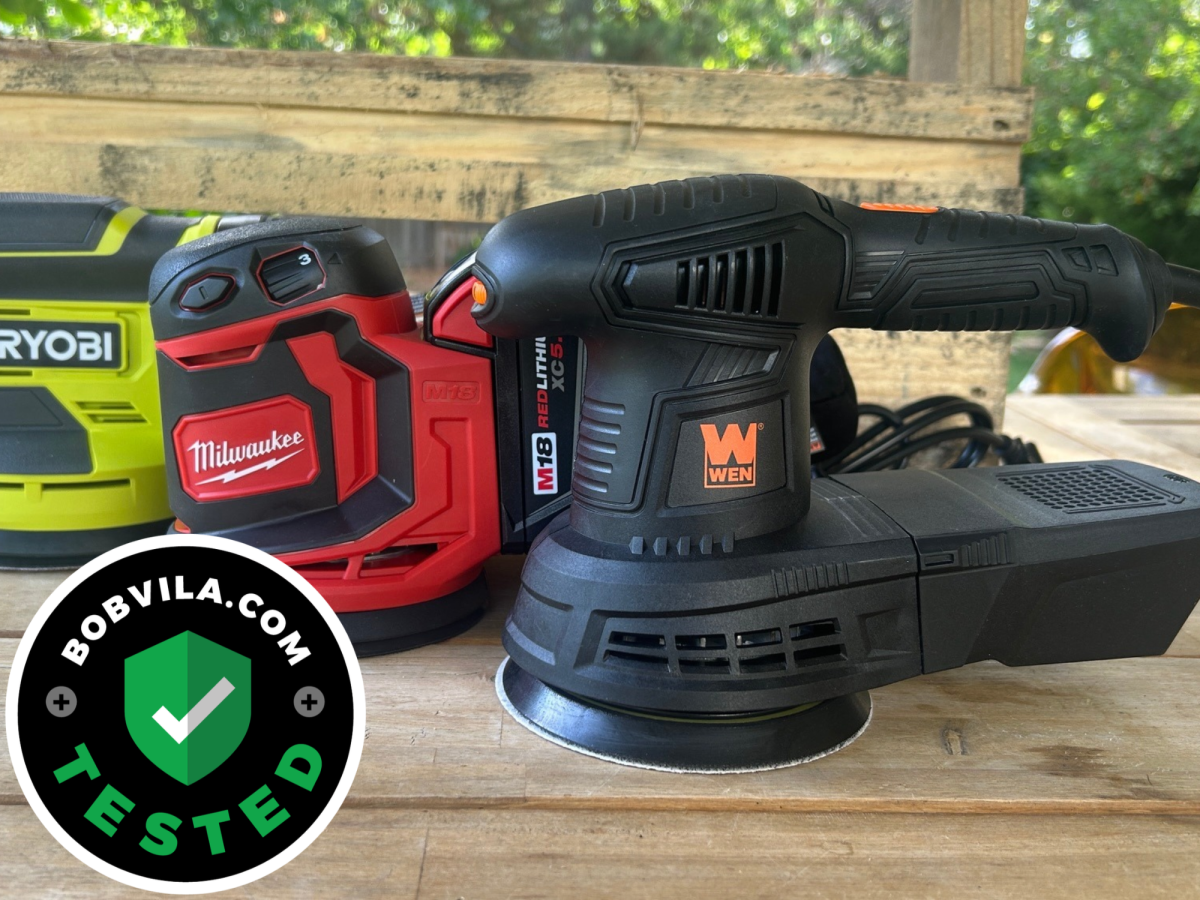
Ten sanders were tested hands-on, and eight were selected as recommended picks. The testing process evaluated ease of use, performance during actual sanding tasks, ergonomics during extended use, and value relative to price. Ratings were assigned on a 5-point scale across those four categories.
All eight recommended models use a 5-inch pad. Speed is measured in orbits per minute (OPM), and the range across the tested models runs from 6,000 OPM on the low end to 13,000 OPM at the top of a variable-speed range. Higher OPM removes material faster but with less control; lower OPM gives more precision on delicate surfaces or fine finishing work.
The Eight Recommended Models
Makita 18V Cordless Random Orbital Sander - Best Overall
Rated 4.7 out of 5 overall, the Makita 18V earned the top position based on its ease of use, three adjustable speed settings, and usefulness across different project types.
The three speeds are 7,000, 9,500, and 11,000 OPM, which covers light finish sanding through more aggressive material removal. It runs on Makita’s 18V battery platform. The battery is sold separately, but the tool is available with a 5.0 amp-hour (Ah) battery that provides up to 65 minutes of runtime at low speed and 32 minutes at high speed. The package also includes a charger, a carrying bag, and a dust-collection bag.
One practical limitation: this sander is described as slightly tall for a palm sander, which may affect comfort during extended overhead or confined-space use. It is compact enough for one-handed operation, though just barely.
Ease of use: 4.7/5. Performance: 4.8/5. Ergonomics: 4.5/5. Value: 4.5/5.
Wen 3.7-Amp Variable Speed Random Orbital Sander - Best Bang for the Buck
Also rated 4.7 out of 5, the Wen model offers a wider variable speed range than the Makita - from 6,000 to 13,000 OPM - powered by a corded 3.7-amp motor. That range gives it flexibility from fine finishing work through faster material removal. As a corded tool, it requires a nearby outlet but eliminates battery management.
DeWalt 3-Amp Single Speed Random Orbital Sander - Best Corded
Rated 4.6 out of 5. This model runs at a fixed 12,000 OPM from a 3-amp corded motor. Single-speed sanders are simpler to operate and can be a reliable choice when variable control is not a priority. The fixed speed of 12,000 OPM places it at the faster, more aggressive end of the range tested.
Ryobi One+ 18V Random Orbital Sander Kit - Best Cordless Kit
Rated 4.4 out of 5. The Ryobi runs at 10,000 OPM on an 18V battery and is notable for being sold as a kit, meaning the battery is included with the tool. For someone not already invested in the Ryobi One+ battery platform, that inclusion reduces the startup cost of going cordless.
DeWalt 20V Variable Speed Random Orbital Sander - Best Cordless
Rated 4.6 out of 5. This DeWalt runs on a 20V battery (sold separately) and offers variable speed between 8,000 and 12,000 OPM. It was selected as the best cordless option based on testing performance, as distinct from the Ryobi kit which was recognized for its value as a bundled package.
Black+Decker 20V Max Random Orbital Sander - Best for Beginners
Rated 4.3 out of 5, the lowest rating among the recommended picks. It runs at a fixed 12,000 OPM on a 20V battery and was designated as the best choice for beginners. A fixed speed reduces the number of decisions required during use, which may make it more approachable for someone using a random orbital sander for the first time.
Milwaukee M18 Random Orbital Sander - Best Heavy-Duty
Rated 4.6 out of 5. The Milwaukee runs on an 18V battery (sold separately) with variable speed from 7,000 to 12,000 OPM. It was selected as the best heavy-duty option, suggesting it performed well on more demanding tasks during testing, though the specific tasks are not detailed in the source material.
Bosch 2.5-Amp Random Orbital Sander/Polisher - Best Ergonomics
Rated 4.6 out of 5. The Bosch is the only model in the group described as a sander/polisher, indicating it is suited for both functions. It uses a corded 2.5-amp motor with variable speed from 7,500 to 12,000 OPM. It was selected specifically for ergonomics, meaning it performed best in testing for comfort and ease of handling over extended use. At 2.5 amps, it has the lowest motor rating of the three corded models tested.
Corded vs. Cordless: A Practical Comparison
Four of the eight recommended models are cordless and four are corded. The practical difference comes down to mobility and runtime management.
Cordless sanders allow work in locations without nearby electrical outlets and eliminate the cord as a physical obstacle during use. The trade-off is battery life - as the Makita’s runtime figures illustrate, a 5.0 Ah battery delivers roughly 65 minutes at low speed and 32 minutes at high speed. Heavy work at high OPM will exhaust a battery significantly faster than light finishing passes.
Corded models provide continuous power without monitoring charge levels. The Wen, DeWalt single-speed, and Bosch all use corded motors, and their OPM figures do not fluctuate with battery state. The limitation is the cord itself: a nearby outlet is required, and the cord can restrict movement or create a tripping hazard depending on the workspace layout.
Whether to choose corded or cordless depends on where the work happens and how long each session runs.
Speed Settings and Surface Matching
Variable speed is not a universal feature. Three of the eight recommended models run at a fixed speed - the DeWalt 3-amp corded at 12,000 OPM, the Ryobi at 10,000 OPM, and the Black+Decker at 12,000 OPM. The other five offer adjustable OPM ranges.
Variable speed matters most when working across different materials or switching between stages of a project. Removing old paint or flattening a rough surface typically benefits from higher OPM. Finish sanding before applying stain or sealer typically calls for lower speeds to avoid removing too much material or leaving swirl marks that show under a clear coat.
For a single-purpose project on consistent material, a fixed-speed sander is a simpler tool. For someone who sands across multiple project types or finishes, variable speed provides more control over the result.
Dust Collection
The Makita is specifically noted as including a dust-collection bag. Dust collection is a practical consideration for indoor work - fine sanding dust accumulates quickly and can be a respiratory irritant as well as a cleanup problem. Whether other models in the group include dust bags or ports for shop-vac connection is not detailed in the source material for each individual model, so that comparison cannot be made here.
If dust management is a priority for the work environment, it is worth confirming dust-collection options for any specific model before purchasing.
Pad Size Across All Eight Models
Every recommended model uses a 5-inch pad. That consistency means sanding discs are interchangeable across the group in terms of size, though the attachment method - hook-and-loop versus adhesive - can vary by model. The Makita uses hook-and-loop disc attachment, as noted in the source. Confirming the disc attachment method for any model affects which replacement discs are compatible.