What You Actually Get When You Spend Less on a Lawn Mower
Spending less on a lawn mower doesn’t automatically mean settling for something that quits halfway through the backyard. The gap between budget and premium has narrowed considerably over the last few years, particularly in battery-powered and manual categories where engineering improvements have outpaced price increases. After hands-on testing of seven models across different yard types, grass densities, and terrain grades, a clearer picture emerges: a few of these lower-cost options perform at a level that genuinely competes with machines costing two or three times as much.
The selection process involved more than reading spec sheets. Build quality, brand track record, how each mower handled thick weedy grass up to 10 inches tall, and how clean the finish looked after each pass - all of it factored in. Price was a hard filter from the start, not an afterthought.
The Greenworks 80V 21” Brushless Mower: Best Overall
Battery Power That Performs Like Gas
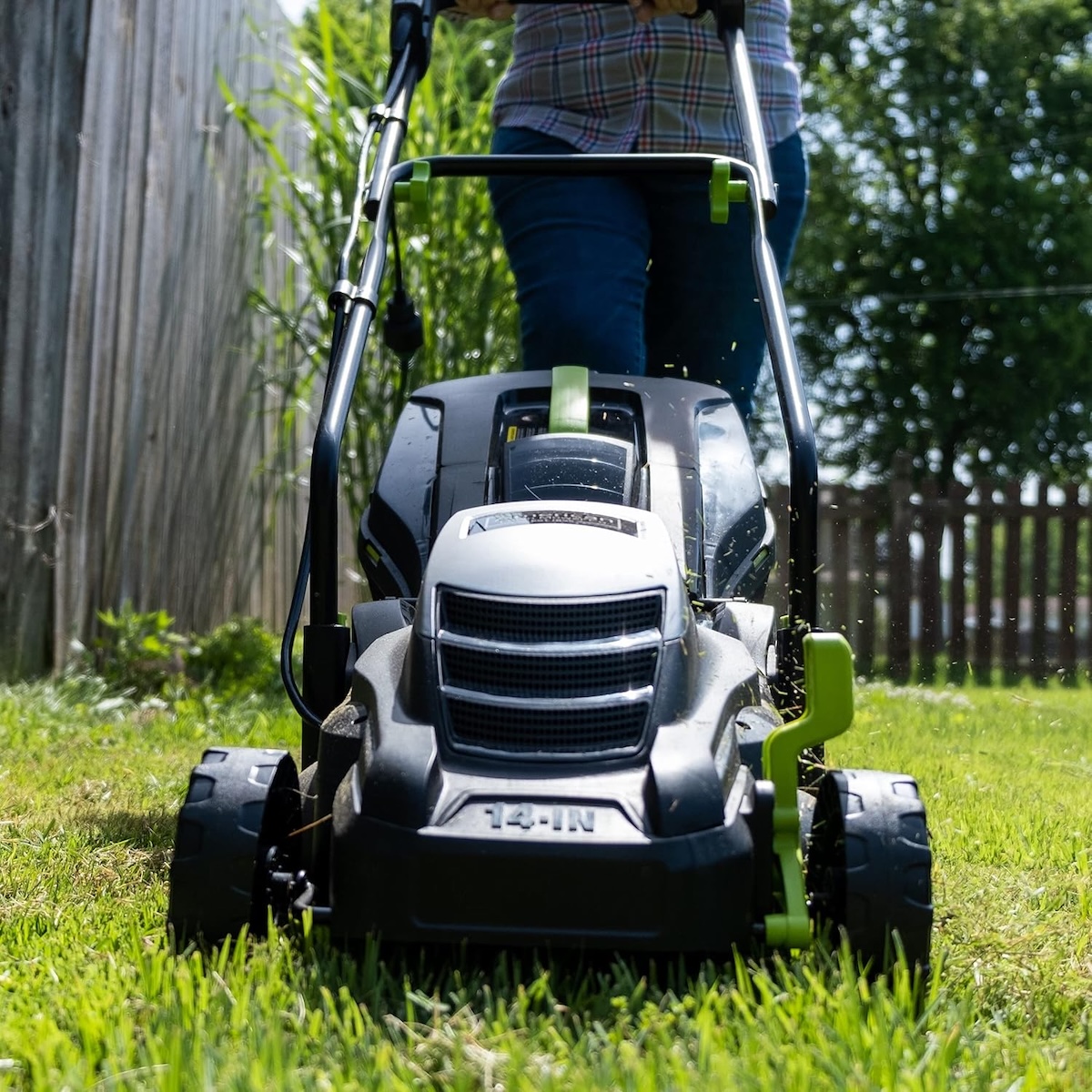
The Greenworks 80V 21” Brushless 3-in-1 Push Lawn Mower runs on a rapid-charging battery and carries a 21-inch steel deck. Its standout feature is SmartCut technology, which reads the cutting load in real time and adjusts motor speed accordingly. That means the mower isn’t burning through battery at full throttle when trimming light spring growth, and it ramps up automatically when it hits thick summer patches. The result is a longer effective runtime and more consistent cutting performance without any manual adjustment from the operator.
During testing, the motor handled dense, weedy grass - including clumps that reached 10 inches - and left a clean, even surface behind. Across all three disposal modes (bagging, mulching, and side discharge), the finish was smooth with no stringy weeds or uneven rows. The mulching performance was particularly impressive: thick clippings were reduced to pieces small enough to be nearly invisible against the lawn.
Two issues surfaced during use. On hilly terrain, runtime dropped - not because the motor strained, but because the operator had to slow the pace, which extended the total mowing time per charge cycle. The side-discharge chute also sat loosely in its mount and came off easily during turns. Neither issue was a dealbreaker, but both are worth knowing before purchase.
The 10-inch rear wheels contributed more than expected to the overall experience. Traction on uneven ground stayed consistent, and the mower tracked straight without much correction on mild slopes.
According to Mark Wolfe, a product tester and writer who reviewed this mower: the Greenworks delivered the strongest mowing capability across all the models tested, left the grass perfectly smooth, and came in at a price notably lower than most comparable options.
Three Disposal Modes, One Consistent Result
What separates a good mower from one that just technically works is how it handles the clippings. With bagging, the Greenworks collected cuttings evenly without clogging in dense patches. Side discharge spread material without clumping. And the mulching mode - arguably the most useful for lawn health - reduced thick grass into fine material that filtered back into the turf rather than sitting on top. That consistency across all three modes means the mower adapts to different yard conditions rather than performing well in only one scenario.
The Fiskars StaySharp 17” Reel Mower: Runner-Up
A Manual Mower That Earns the Price
The Fiskars StaySharp 17” Reel Mower is a manual push mower - no battery, no fuel, no motor noise. Before gas mowers became the standard, reel mowers were how lawns got cut, and the basic design hasn’t changed much. What Fiskars has changed is the mechanism. The InertiaDrive system is patented and designed specifically to power through dense clumps and difficult patches that would stop a standard manual reel mower cold.
Most manual mowers lose momentum in thick grass and require the operator to back up and take another run at the same patch. The InertiaDrive system addresses that specific failure point. The result is a mower that works in conditions where other manual options simply stall.
The Case for Buying Once
The Fiskars StaySharp is a durable, long-term purchase rather than a seasonal appliance. Treat it reasonably well - keep the blades clean, store it out of weather - and it’s the kind of equipment that doesn’t need replacing for years. There’s no fuel to manage, no battery to degrade over charging cycles, and no motor components to service. The 17-inch cutting width is narrower than the Greenworks’ 21-inch deck, which makes it better suited to smaller yards or tighter spaces where a wider mower becomes awkward to maneuver.
Matching the Mower to the Yard
Small Yards and Corded Electric Options
Corded electric mowers carry a cost advantage that’s easy to overlook: there’s no battery degradation over time, and the power supply is consistent from the first pass to the last. For yards small enough that a cord doesn’t become an obstacle - typically under a quarter acre - a corded model eliminates the runtime question entirely. The trade-off is obvious: you’re working around a cord, and any yard with irregular shapes or tight obstacles makes cord management more complicated than it’s worth.
Robot Mowers as a Long-Term Equation
Robot mowers carry a higher upfront cost within the budget category but change the math when time is the real expense. They operate on programmed schedules, handle regular maintenance cuts without any operator involvement, and keep grass at a consistent height rather than letting it grow tall between sessions. The limitation is that they work best on relatively flat, simple layouts - complex yard geometry with multiple obstacles slows them down and reduces their efficiency. For straightforward lawns, they offer a genuinely different relationship with the mowing task.
Wide Deck Mowers for Larger Lots
A wider cutting deck reduces the number of passes needed to cover a given area, which translates directly to less time spent mowing. For larger yards - anything over a half acre - this matters more than any single performance feature. The trade-off is that wider decks are harder to maneuver in tight corners and around obstacles, so the efficiency gain in open areas gets partially offset by extra effort around trees, garden beds, and fence lines.
Gas Mowers Still Have a Case
Gas mowers remain relevant in the budget category for one practical reason: raw power in demanding conditions. Battery technology has improved substantially, but in very thick, overgrown grass - the kind that hasn’t been cut in weeks - a gas engine still produces sustained torque that battery motors approach but don’t consistently match. For lawns that get irregular care, or where growth gets well ahead of the mowing schedule, a gas mower is a more forgiving choice.
The maintenance overhead is the honest counterargument. Oil changes, air filter replacements, fuel stabilizer for off-season storage, and spark plug checks are ongoing costs and tasks that battery and manual mowers simply don’t require. Over several years, those cumulative costs narrow the price gap between a budget gas mower and a slightly more expensive battery option.
What the Price Range Actually Covers
Across the seven models reviewed, the pricing reflects real differences in capability, not just brand positioning. The Fiskars reel mower sits at the lower end of the range - and for a yard that suits it, that price buys something genuinely durable and maintenance-free. The Greenworks 80V represents the higher end of the affordable category, and its SmartCut technology and 21-inch steel deck justify the difference for anyone with a mid-sized yard and varied grass conditions.
The Greenworks 80V 21” Brushless 3-in-1 Push Lawn Mower is available at Amazon and Walmart. The Fiskars StaySharp 17” Reel Mower is stocked at Amazon, Ace Hardware, and Walmart - making either one relatively straightforward to find without waiting on specialty orders.